
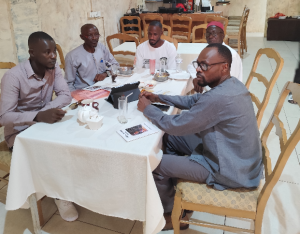
On the evening of July 27, 2025, at the Seafood Restaurant in Senegambia, The Gambia, Dr. Lang Fafa Dampha, Executive Director of the Pan-African Centre for Cultures and Languages (PACCL), convened a key meeting with national stakeholders to discuss strategic initiatives aimed at promoting indigenous languages within the country’s educational and technological sectors. The meeting, held from 18:30 to 19:30, brought together a focused group of participants, including Mr. Kitabu Jabang, Head of National Languages and Mandinka Instructor, Mr. Kawsu Njie, Information and Technology Officer, along with invited guests Mr. Kabiru Jammeh and Mr. Kemo Dampha. Mr. Mamudu Tarawally, Head of the Sarahuleh Unit and Instructor, and Mrs. Kodu Jeng, Head of STEM and African Languages, were unable to attend due to prior commitments.
The main objective of the meeting was to present PACCL’s mission and strategic goals while identifying actionable pathways for deepening institutional collaboration around national languages. Discussions covered a wide range of areas, including the establishment of National Language Committees, the need for orthographic harmonisation, and the integration of technology into language preservation and instruction.
Dr. Dampha opened the conversation by highlighting a core contradiction in The Gambia’s development efforts: the pursuit of national advancement predominantly through a foreign language. He stressed that this structural imbalance has long sidelined indigenous languages, preventing their full contribution to authentic national progress. According to Dr. Dampha, sustainable development in The Gambia requires embedding indigenous languages more deeply into public life and especially the education system.
He laid out key recommendations to address this imbalance. Firstly, national languages must be institutionalised as mediums of instruction, particularly in early childhood and primary education, where children learn best in their mother tongue. This approach enhances cognitive development, improves comprehension and fosters a sense of identity. It also builds a stronger foundation for learning global languages like English or French. To support this, he called for a revision of policies to officially recognise national languages in foundational schooling.
Secondly, he emphasised the urgent need for the development and distribution of pedagogical materials in languages such as Mandinka, Wolof, Fulfulde, Jola and Sarahuleh. These resources must be culturally relevant and age-appropriate, produced through collaboration between linguists, educators and native speakers. With quality learning materials in their native tongues, both teachers and students would experience improved engagement and educational outcomes.
Thirdly, Dr. Dampha recommended launching public campaigns to promote the use of national languages in all aspects of life. These languages should no longer be confined to informal settings, but rather be embraced in governance, media, religion, commerce and the arts. Public awareness efforts, amplified by cultural figures and youth influencers, would elevate the status of indigenous languages, encouraging their integration into everyday life.
In this context, he argued that institutionalising national languages in schools, producing high-quality teaching materials and shifting public perception are all essential to building a linguistically inclusive society. These initiatives would not only enhance learning outcomes but also help safeguard The Gambia’s linguistic heritage.
The meeting also reached consensus on the formation of dedicated National Language Committees for major languages including Mandinka, Fulfulde, Wolof, Sarahuleh (Soninke), Jola and Manjak. These committees would oversee language development, translation, terminology creation and policy recommendations.
To ensure their success, Dr. Dampha outlined that each committee should have a formal mandate, clearly defining its scope and objectives such as the creation of orthographies, curriculum design, and media production. He advocated for inclusive membership, drawing on linguists, educators, community leaders and native speakers to ensure technical rigour, cultural relevance and local legitimacy. Furthermore, he proposed that all committee activities align with regional and continental frameworks such as those promoted by the African Academy of Languages (ACALAN), the East African Kiswahili Council (EAKC), the International Centre for Research and Documentation on African Traditions and Languages (ICRDATL) in Yaoundé. Harmonising national efforts with continental bodies would unlock resources, expertise and policy support, positioning The Gambia as a leader in African language development.
One of the more innovative proposals discussed was the creation of “Gambian Language Boxes”, compact, modular kits designed to facilitate language learning and development. These kits would combine traditional and digital tools, including primers, grammar books, storybooks and games alongside mobile-accessible audio recordings and interactive learning content. Dr. Dampha recommended that these Language Boxes be distributed through schools, community centres and diaspora networks, supporting both formal education and informal learning. He suggested launching a pilot programme in bilingual regions to gather user feedback and refine the boxes before scaling up nationwide.
The meeting also covered capacity building for national language education. Participants agreed on the need for formal training programmes for language instructors and curriculum developers, equipping them with skills in pedagogy, literacy methods and culturally grounded material development. Regional collaboration with institutions like ACALAN and the Kiswahili Council of Tanzania (BAKITA) was encouraged to standardise certification, training modules and joint research. Moreover, the integration of robust monitoring and evaluation tools was proposed to track student progress, teaching effectiveness and programme impact.
Mr. Kitabu Jabang provided a focused case study on Mandinka language instruction, identifying both growing interest and pressing challenges. He noted that many young Gambians and diaspora communities are eager to reconnect with their roots, yet face a shortage of updated and standardised teaching materials. Digital content in Mandinka is scarce, and the absence of a standard orthography causes confusion and limits broader usage.
To address this, he proposed digitising Mandinka texts such as folktales, oral histories and educational content, and developing digital learning tools including mobile apps and audio lessons. Standardising the writing systems of national languages through expert and community consultations was also recommended to ensure clarity, consistency and widespread acceptance.
Dr. Dampha concluded by presenting a digital vision for advancing national language development. He outlined plans for a central online repository of language materials and proposed leveraging AI tools for transcription, translation and voice-to-text functionalities. He emphasised the need for e-learning platforms and mobile apps to reach rural areas and diaspora communities. While digital tools offer transformative potential, he cautioned that limited ICT infrastructure and local technical capacity remain significant barriers.
Importantly, there was strong consensus on the cultural importance of national languages in shaping identity, unity and social cohesion. Mr. Jabang advocated for a comprehensive national language policy and inclusive communication strategies across public institutions, media and publishing.
The meeting concluded with several key action points. A follow-up workshop will be organised to identify and prioritise language materials for digitisation. PACCL’s Executive Director will engage relevant government ministries to advance the integration of national languages into the school curriculum. A working group will be established, comprising Mr. Kitabu Jabang, Mrs. Kodu Jeng, Mr. Kawsu Njie, Mr. Mamudu Tarawally, and representatives from civil society, who will work in collaboration with PACCL’s language technology expert to design a pilot digital platform for national languages. Additionally, proposals will be developed to attract international partnerships and secure funding for ongoing language development and digitisation efforts.
In summary, the meeting marked a turning point in The Gambia’s approach to indigenous language development. It laid a strategic foundation for blending traditional knowledge with modern technology and policy reform, setting the stage for national languages to become central to education, governance and cultural identity. As The Gambia positions itself at the forefront of African language revitalisation, PACCL’s leadership continues to demonstrate the power of inclusive, innovative and culturally grounded approaches to national development.